Sunday, March 23, 2014

Blog Post #29

This past week, as we finished our essays on What Dreams May Come and wrapped up our Divine Comedy project, we began reading Franz Kofka's The Metamorphosis. Kofka is known as one of the most influential modernists in all of history, and The Metamorphosis is one of his best works. It opens up the human mind to the ideas of self-oppression, inner tunnel vision, and most of all, self-loathing. Kofka is a hard piece to read mostly for the extreme sadness expressed, and I haven't read too far in it yet. So far, I have only seen one layer of symbolism expressed: blindness. "The stresses of selling are much greater than the actual work going on at head office, and, in addition to that, I still have to cope with the problems of travelling, the worries about train connections, irregular bad food, temporary and constantly changing human relationships, which never come from the heart." (Kafka, 2) The main character, not even having the slightest concern that he is now a vile bug of some sort, is repressing himself. The dark, twisted reality he has cornered himself into is just now catching up to him, and yet he still refuses to acknowledge it. "'What’s happened to me,' he thought. It was no dream. His room, a proper room for a human being, only somewhat too small, lay quietly between the four well-known walls." (Kafka, 1) The horrible soul-crushing world he lives in is almost too hard to bear, so his mind has created a new one for him.
My prediction for the plot of this depressing story is with a bleak outlook. I think it is only going to get harder to read. I have barely made it past the first few pages and I'm already feeling a little suicidal. There is hints that the main character will persevere and the plot will come to a happy ending, but by this point in the year I know better. I think that the story of this lonely bug will come to a devastating end.  "They would only have had to push their arms under his arched back to get him out of the bed, to bend down with their load, and then merely to exercise patience so that he could complete the flip onto the floor, where his diminutive legs would then, he hoped, acquire a purpose." (Kafka, 3) The reason I believe this story will end grimly is summed up in this phrase. As a normal person would react to this situation as a complete horror, Gregory is simply trying to carry out his day. He is blind to anything in the future except what he is told, and the end result is not always pretty for people of that nature. He is too caught up in the rat race, as some would say. "Things are not yet going as well as I thought. But things are all right with me. How suddenly this can overcome someone! Only yesterday evening everything was fine with me." (Kafka, 5) Gregory is a prisoner to himself, and to everyone trying to keep him free. Sometimes when you work so hard to become something, you get there only to find you have nothing to show for it. Life is complicated like that, and without stopping to smell the roses every once in a while, you could be doomed to live a very sad, dark life. You may not turn into a bug, but you will be no better than one.


Monday, March 17, 2014

Blog Post # 27

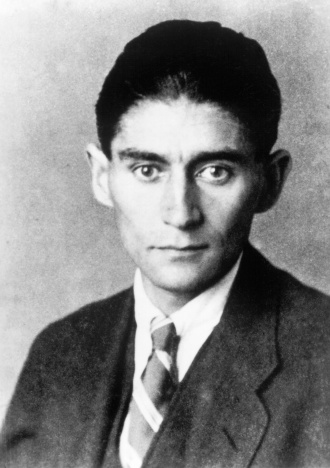
Franz Kofka was a German-language novelist of the 1880, and was one of the most influential writers of his time. Born in the Prague, Hungry (now the Czech Republic) on July 3, 1883, Kofka lived in a modest home with his middle class family outside the Old Town Square. He was raised by his mother, Julie Kofka in his home with five other brothers and sisters until he was sent to school in 1889 at a German boy's elementary school outside of Mansa Street. Franz was raised by the Jewish faith, and of the time it was expected that a Jewish boy would get good grades and exceed educationally in school. Franz did, and never thought of himself as much more. He did well, but did not pursue any kind of higher education after a few years of Philosophy at Warsaw. He was said to be a shy boy, never really having much to say but when he did it was profound.


After his studies, Franz went out into the world and was first hired by an insurance company. Franz worked there for less than a year, and didn't enjoy it much. It took too much time out of his writing-which was growing in importance. Franz was said to develop the first "hard hat" for worker's safety while at the firm, but his job never took off that much from there. He was a simple paper-pusher, and was only working to keep food on the table. In 1915 Franz received a letter for the draft of WWI, but due to his tuberculosis he was diagnosed with soon before kept him out. He tried to enlist many times, but the army wouldn't accept him. Franz never seemed to have time for a family, but he did admit to be tortured by sexual addiction. People often regarded him as emotionally repulsive, and not someone that you would want to hang around with. He had a dry sense of humor, and didn't posses much of a personality to mention. Later in his life he found an interest in swimming which he proved to be quite good at, but soon that too had to be sacrificed for more writing time.


Franz Kofka had many influences on people not only of his own time, but is still opening people's eyes today. His writing was inspiring, dark, and very well written. He inspired a form of fluency called "Kafkaesque" to set in motion a whole act of speaking out against injustice, particularity in Germany, and is commemorated in Warsaw every year. Kafka is rarely quoted by others, but many idealists have similar opinions as his stated in his books. Kafka often painted a picture of a dark, strict bureaucratic world. His symbolism and influence helped shape our world today, and has been used to stand out against tyranny all throughout history.


Franz Kofka died on June 3rd, 1924 at the young age of 40. His influence lived on, but he as a person was gone forever. As a result of the tuberculosis he had been suffering from since a child, his condition worsened into a terrible throat problem. His official cause of death was starvation, but only because his throat made it too painful to eat. At his funeral, only his immediate family mourned. Franz was not yet famous, and his ideas weren't always shared mutually. We now know that he was a great writer, and even if he wasn't the most fun person to be around socially, its what he spoke out against that counts. His first piece, The Metamorphosis, wasn't published until almost 20 years after he died.


Nervi, Mauro M. "The Kafka Project." The Kafka Project. Linkit, 06 June 1990. Web. 18 Mar. 2014. <http://www.kafka.org/>.

Saturday, March 15, 2014

Blog Post # 26

As we transition from Dante's Inferno and begin our evaluation of Vincent Ward's What Dreams May Come, we were asked to compare the two works in a way that each of these pieces would reflect each other. After hearing all the presentations about Dante's Inferno and watching What Dreams May Come, I see that there are many similarities and references to Dante in the film. The first and most symbolic of all the relations was Chris Neilsen's guide into Hell, The Tracker. He is the depiction of Virgil. Both are guides into the underworld, and both act as a mentor to the one they lead. Later on the watcher finds out that The Tracker is actually Albert, the medical expert Chris trained under in college. Albert led Chris in his life, and now he leads his soul through Hell. They have a special kind of relationship, one that allows them to always count on each other. It also shows the path of life, in the sense of the soul. Albert was black in a physical condition on Earth, but his soul always viewed himself as the old wise man he was when he appeared to Chris in Heaven. Together they pass through many regions of Hell similar to those described in Dante's Inferno. The gates of Hell is a ship graveyard, filled with battleships and other wreckage. Violent, tortured souls slum about, waiting to be lowered in through the gates. The first level, or plane, they both reach is the "sea of faces". This is the Illustration of The River of Styx. It is not exactly the same, but you can see the connection. When Chris falls into Annie's personal Hell, he finds it to be their house in a giant upside down church-the church they were married in. This is using Dante's idea of Contrapasso. The sin the soul commits should fit the crime. Each person is punished differently, but they are all divided up into different levels. Albert helps Chris, telling him to make sure he comes back out of the house in under three minutes otherwise he will be pulled down into Annie's world she created for herself. When Chris decides to stay with Annie, Albert helps them both escape before both of them got stuck in Hell forever. Albert is not only a great friend that Chris will have for many more lives to come, but also the ideal Virgil to him. He fits the part, and plays it beautifully.
The second most notable association between Dante's Inferno and What Dreams May Come is the gates of Hell. Both appear as a huge, gaping, horrifying place that you usually wouldn't return from. They both symbolize the many people sinning, for the gate is swarmed with incoming souls in both these pieces. Each of the main characters make it back out of Hell, and are both led by a guide through the gate. The entrance of Hell is a dark place, one with people of all wars and all sins, usually violent ones. The gates of Hell in What Dreams May Come  is a ship graveyard, filled with all the tired souls of soldiers and sunken battleships. This is the wrathful level of Hell. You could get lost in it, and all those waiting are violent, not saying that soldiers go to Hell. The main and final ship is called the Cerberus, the three headed dog of Greek Mythology that is so often used in Dante. Everything is red and burning, and all the souls carry a white flag - surrendering their will and giving in. War is Hell, and this representation in both of these works says something. The use of boats as the main form of transportation all throughout What Dreams May Come is symbolic, its trying to make it seem older and more connected to Dante. The colors noted all point to those represented in the many Cantos of Hell, and the sense of life and what to make of it ties in with Dante's reason for writing The Divine Comedy. In the end, both of these works were working for one simple thing: the realization of what happens when we die, be that good or bad. There are different beliefs, different religions, all kinds of opinions from all over the world but one may never know for sure until it happens. Life is a mystery, but not one to solve. Dante's Inferno and What Dreams May Come are both beautiful representations of what the afterlife could be.


Monday, March 10, 2014

Blog Post #25

All this past week, we have continued to present our Dante's Inferno projects. It has been going well, and not a lot of people have been absent. Basically, we have been counting up through the levels of Hell, deeper and deeper into the center of Earth. The last Canto is obviously where Satan resides, and I think we are only two away from wrapping it all up. Personally,I think it's fun to see all the sins and their ironic Contrapassos. It is interesting to see which sins Dante sees as almost unforgivable, and which are punished the most severely. Overall, it is a good learning experience and I find it more rewarding to present something to the class visually instead of just having a paper to read. Prezi is a little complicated, but it always looks good and having something you made to prove you took the time gives you a deeper, more personal understanding.

Out of all the projects we have seen this week, the two I like the most were Noah's and Tiffany's. I liked Noah's mostly because he did a good representation of falsification. His idea to fill a pinata with brussel sprouts was tricky. It was mischievous and insidious, a perfect visual for his Canto. It went well with the symbolism of the Trojan horse too, and the way he linked it to other historical events. It was a solid presentation, and it was obvious that he really cared. He did a good job, honestly. Tiffany's was the other presentation that I enjoyed the most. She really didn't do a good job explaining it, but she did make a nice jail cell for her visual. She had a hard Canto to dissect, but I think she gave it her best in the time she was provided with. All of the projects I have seen so far have been great, but these ones stand out the most. The artwork, the presentations, and the all-around positive attitude on such a dark subject was really enjoyable for me. I think this project, even though scary and violent on the surface, has had a positive impact on me.


Sunday, March 2, 2014

Blog Post #24

For the first half of this week, everyone was given work time in class to collaborate and ask any questions they may have. Everyone seemed to be understanding it well, and the syllabus helped a lot. It seemed like a lot of work, but it really wasn't that much. Depending on how many Contrapassos the Canto had, it was either a little work in a little amount of time, or a lot of work it a lot of time. Parts of it was a little consuming, but in the end it will be interesting to see how all the Cantos fit together. The story of Dante through his Divine Comedy is an interesting one. It would be even more interesting to read Dante's Paradiso. Hell is a little depressing to read about. 
As a personal reflection of the week, I did not enjoy it. I felt rushed, and I was absent the day I was supposed to present my Canto. I had a small family emergency, and as a result didn't get much of the project done anyway. I really didn't like relating a part of our world to Hell, that seemed a little too dark for me. Overall this project was a really good learning experience, but I would have liked to get the same experience out of a happier story. Dante's Inferno is a disturbing story, and I think that it may be pushing the limits of religion in public schools. Overall, I am glad for this project, but in the same sense that I'm just glad it's over.


Saturday, February 22, 2014

Blog Post #23

Last week we finally started our Dante's Inferno project. We all chose a specific Canto of Hell to research and evaluate, and I chose the 8th Canto-the Wrathful level of Hell. We were given time in class to work on  citing and planning our project, and so far everything has been pretty easy. I know it will get harder, but for now all I have to worry about is my visual presentation and paraphrasing the text. It is challenging enough to simply read the text and understand what is going on, but to find the deeper meaning of it is going to take some serious research. I have a general understanding of Dante's Inferno, but I still don't know it as well as I would like to. I honestly don't know why we are even reading this apart to test our evaluation skills and have a better understanding of classic literature and satire. 
I haven't thought about it much, but for my visual I was mauling the idea of making a painting of some sort. The river of Styx is in the 8th Canto of Hell, and the entrance to the city of Dis is at the end of it. I could have a dark painting of the city in the back, and Dante and Virgil in the skipper crossing the river of Styx in oil paint. It might be hard to make it all come together, and I think I will be using mostly black and red for this, but I never really liked dioramas or models. They seem awkward to carry, and usually end up getting bent or broken. I might also just make a fake map of the 8th Canto to present, although I don't think that would be as interesting as a painting. Either way, I am enjoying this project and know that I will get something out of it even if I get an "F" on the final grade. I hope it doesn't come to that, but it might. 


Friday, February 14, 2014

Blog Post #22

As we transition from our tragic hero evaluation project and into a new study of dark literature, I would like to wrap up the past week and begin to describe what our new project is. First, I would like to say that our poster presentation went well. We all seem to have a solid idea of what a tragic hero is, and I think our poster looks good hung up on the wall. I will admit that some other posters were a bit better looking than ours, but with what we had and in the time that was given, I think it looks great. I liked how everything came together at the end, and we had all group members on board when we finally presented. I hope to get a good grade on this project, and I feel that my fellow group members deserve an A.
Now, as we have finished our study on the tragic hero, a new project and a new piece of literature must begin. For the next month or so, we will be reading, discussing, and evaluating Dante Alighieri's Dante's Inferno. I am not yet sure what the final project will be, but I know I will enjoy reading this. When I was younger I attempted to read this script, but I don't think I understood it completely. I just thought it was a story describing Hell. I now know that it is much more than that. I hope to get a more complete understanding out of this as we read it again, and hope to gain some personal knowledge too.